How MM Romance Went Viral
Updated: Jun 3
The Bothered Blog by Lucy Lennox and Clare London
May 2026
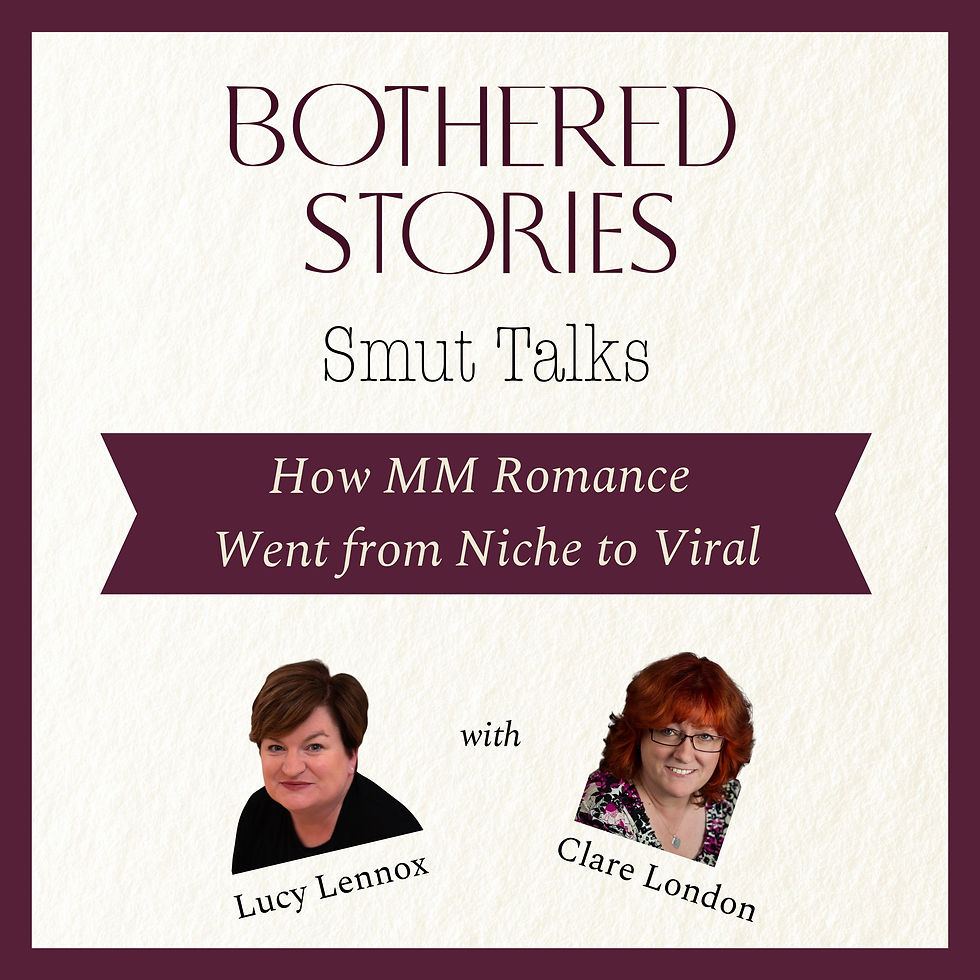
MM romance has been building devoted readerships for years, but 2026 feels like a tipping point. Between the explosion of interest around Heated Rivalry and the growing visibility of MM stories across publishing and entertainment, what once was niche is now impossible to ignore.
Allison Whaley sat down with authors Lucy Lennox and Clare London to talk about why readers love MM romance, how the genre has changed over the last decade, and what it has meant to build careers writing stories that, for a long time, many struggled to understand.
This interview is adapted from a conversation in our podcast series, Smut Talks (available on Apple and Spotify).
Why women love MM romance
Allison: Why MM? Why are women so drawn to these stories?
Lucy: I think that when the love interests are the same gender, it takes the gender junk out of the story and problematic tropes change completely.
Take the damsel in distress: it’s hard for me to read a MF romance where the woman needs the big strong man’s protection. I don’t want to be rescued by a big, strong man. I want to be strong. So identifying with the damsel in distress character is very problematic for me, and I can't allow myself to enjoy it.
However, if in a similar story with two male characters, you have one who's in trouble and one who’s the protector, I can imagine myself as either one. The culture around me isn’t insisting that I self-insert as the one in trouble.
Reading about two men in a lot of the tropes I happen to love is very much a relief. I can enjoy it without feeling like there's any sexism involved.
And the other thing is that we see two men being gentle, or tender, or thoughtful towards each other—men carrying the mental load more than we feel like they do in our own personal relationships. That’s very appealing. A lot of what draws us to any kind of romance is this relationship that doesn't necessarily exist in our real lives.
Besides, why wouldn’t a straight woman want to read a story about two sexy men?
And honestly, even asking this question is misogynistic. Are women not allowed to consume porn? Are we not allowed to consume erotica? There's so many different takes on why women love MM romance, but a lot of them come down to a different standard for women than men.
The evolution of MM romance
Allison: You've both been writing in this space for years. What changes have you seen?
Lucy: When I started writing MM romance, even only 10 years ago, I worked in a big bookstore and gay romance was shelved not in the fiction area but in LGBTQ studies. That’s where you’d find a memoir, a textbook, anything like that. And gay fiction was in the very back corner of the store, on the bottom shelf.
Clare: That’s how MM romance was seen. It was shelved as erotica, a sort of smirky, filthy little secret.
But, no, it's not. We are writing fully-fledged stories about characters who have lives and romances and loves, and the only reason that’s questioned at all is because of misogyny.
Heated Rivalry and mainstream attention
Allison: Recently, MM romance has reached a broader audience. Did Heated Rivalry feel like a turning point?
Lucy: For the first time in ten years of me doing this, I can go get my hair cut and my hairstylist has heard about gay romance novels as a thing.
It used to be that when I tried to explain to people what I do for a living, everybody looked at me like I'm weird. Like, why do you. . . but you're not a gay man, like, wait. . . what? Why would you do that?
But I can go out into the world now and say, hey, you know Heated Rivalry? That's what I write. Books like that.
When my daughter went back to college for her second semester, the first slide in her communications class was Heated Rivalry. And there were sorority girls on campus doing Heated Rivalry themed parties.
She’s grown up around gay romance, she was 9 when I started. But I chose a pen name for my family’s security and privacy. I live in the south. It’s conservative. I had nightmares of my kids' friends getting a hold of my sex scenes and reading them on the school bus to taunt my kids. And so for a long time, I didn't even tell my friends in the neighborhood what I do for fear that their kids would overhear them talking about it, and bully my kids because of it.
So it’s very exciting to see the mainstreaming of queer acceptance and queer love, and Heated Rivalry helped to mainstream it so much more.
Women writing MM romance
Allison: You've probably heard this question many times: How can women write MM romance?
Lucy: I get asked this almost every time somebody finds out what I write. It’s the most common question. How do you know how to write that? Especially in regards to the sex.
Clare: My response to this question is: I’m not a vampire. I’m not a unicorn. I’m not a serial killer. We’re writing fiction, and we write what we can imagine. And we do research. With my writing, I always hold myself accountable to the motto: do not harm. I’m not going to represent someone wrongly. I don't believe there's any reason you shouldn't write about anyone, so long as you do it with respect.
Lucy: Nobody asks non-doctors how they write doctor characters. That's not a question that ever gets asked, ever. Because the assumption is that you research it, or that you have doctor friends, you've been around doctors your whole life.
This question really bothers me: the implication that women need to experience every sex act before they write about it is just ridiculous. There are best-selling romance authors who have written very steamy, successful books, who've never had sex, ever.
This question is a way of telling somebody that they are in a space they shouldn't be. I was very apologetic and defensive about this at first. And it really bothered me for a long time.
Of course, we need to be incredibly mindful of not causing harm. But implying that women writing about gay men is fetishization, which is a real common comment, is reductive, unfair and harmful.
Sometimes, this question has good intentions, aiming to point out that “own voices” need a seat at the table. And absolutely. Having a platform as large and successful as I do, I need to make sure that gay men writing gay male stories are getting heard and not overlooked.
But I think that the table is big enough for a lot of us.
---
About the Authors
Lucy Lennox is the USA Today bestselling author of over fifty gay romance titles including the GoodReads Hall of Fame winner Wilde Love. Born and raised in the southeast USA, she is finally putting good use to that English Lit degree she earned before the turn of the century. For more information and to stay updated about future releases, sales and audio news and to grab some free and bonus reads, please sign up for Lucy’s author newsletter, or to stay in the know, join her exciting reader group, Lucy’s Lair on Facebook.
Clare London writes male/male romance, with over 50 titles published, both traditionally and as an independent, and her strong, sympathetic, and sexy characters have won many loyal fans as well as awards. She ran the UK Meet fiction networking event for 10 years, and loves to meet readers at author signings. Find all her work and news at www.clarelondon.com.


Comments