When Women Are the Punchline: US Women's Hockey Wins Gold
The Bothered Blog by Allison Whaley
March 2026
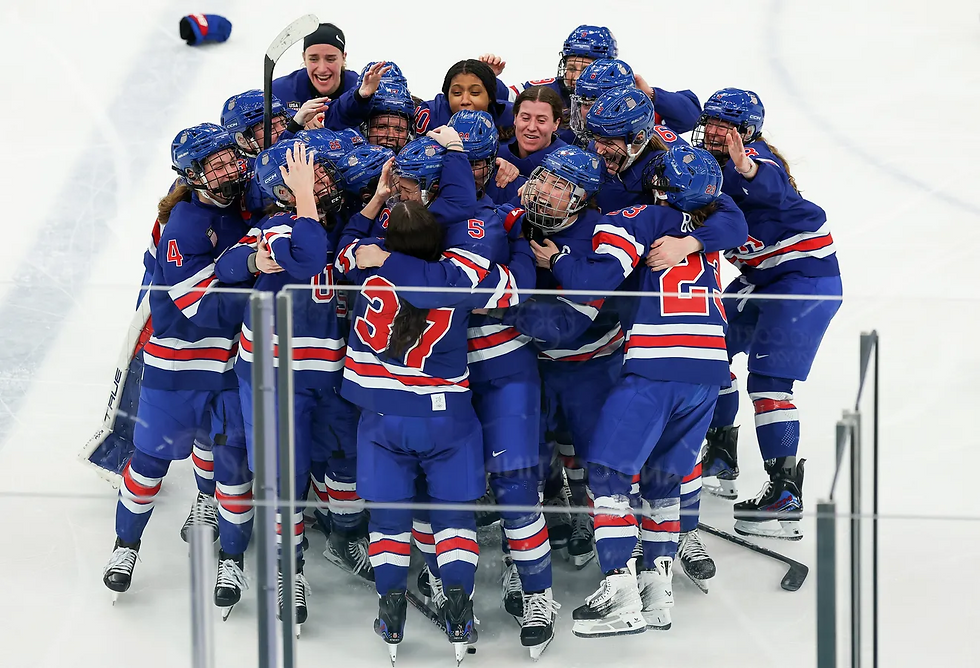
At the 2026 Winter Olympics in Milan, both the U.S. women’s and men’s hockey teams achieved the same extraordinary accomplishment: they won gold medals. The women’s team did it first, defeating Canada 2–1 in overtime on Thursday, February 19. Three days later, on Sunday, the men’s team followed with their own gold medal victory.
Shortly after the men’s win, a video circulated showing a phone call between President Trump and the men’s team, recorded in the locker room. In the call, the president congratulated the team and invited them to visit the White House, offering to fly them there on a private military jet. Then, as an aside, he added that he would “have to invite the women’s team too,” joking that otherwise he’d be impeached. The room laughed. In that moment, the women’s team—who’d won the same gold medal, three days earlier—became the punchline of a joke. The implication was clear: the invitation wasn’t something he wanted to extend, and extending it was laughable.
I can think of a lot of apt responses to Trump’s comment. “They won three days ago. You haven’t already invited them?” Or, “Wait, they earned the same medal as us. Why wouldn’t you want to invite them?” Even just a simple, “Huh. This feels kind of bad to me.” None of these were spoken, and while a few team members later apologized, the playbook of “misogynistic comment → public apology later” is a tired trope.
Worse still is that some apologies reinforced a dismissal of the very real harm caused by misogyny. Jake Sanders, a member of the US Olympic team, cited their team’s regular meals with the women’s team as proof of respect, as if that excused the joke. ("If we were to do it again, I think we wouldn't do that and we made a mistake. But again, I think it kind of got blown out of proportion a little bit. You know we love the women, eat lunch with them, like I said before, so nothing but the upmost respect for all of them” source). For me, his response epitomizes a culture that uses women’s participation in everyday activities (e.g. sharing a meal) as a deflection for the devaluation of women and a dismissal of the damage it perpetuates.
Let’s return to the moment of the video: when I saw it, I had feelings.
When I heard the men’s team chuckling—how the women were turned into the punchline of a joke—I felt a corresponding sucker punch to my gut, and it wasn’t just for the women on the Olympic hockey team. It triggered something personal. Something familiar. It reminded me of the jokes about women that predominated my upbringing. Jokes I heard as a young girl from family members, from friends, from the adults who were supposed to be teaching me right from wrong.
You’ve probably heard them, too:
“Ball and chain” jokes framing marriage as the end of a man’s freedom, women as controlling or nagging, and life with a woman as bleak (“My wife asked me what I wanted for dinner. Apparently ‘a divorce’ wasn’t the right answer.”)
The worn-out stereotype that women are less skilled or intelligent than men (“Why couldn’t Hellen Keller drive? She was a woman”)
The casual quip that women are “too emotional” to be taken seriously.
I was a blonde child, and I’m a blonde woman today. “Dumb blonde” jokes proliferated in the culture around me growing up and were sometimes directed at me—brazen, inaccurate teases, given that I was a smart, athletic child, top of my class. “Why did the blonde stare at the orange juice carton? Because it said ‘concentrate.’” “How do you keep a blonde busy? Write ‘flip over’ on both sides of a piece of paper.”
Back then, I never wondered why boys with blonde hair didn’t receive the same treatment.
I don’t wonder now, either. I know why.
It’s because our culture upholds a misogynistic belief system that devalues women—a belief system that continues today. And if you don’t believe that, go watch the video and see for yourself.
To be clear, I don’t think that most men would make a joke like Trump did. The important men in my life, for example, I know would not. It’s that far too many men—like the athletes in that locker room—stay silent when those jokes are made.
And whether you like it or not, silence enables. Silence upholds. Silence supports.
Maybe you wonder whether jokes about women matter. Whether they impact us. For some men, like Jake Sanders, I can imagine the urge to downplay is strong.
As someone who grew up with this language normalized and who watched our president use it today, let me set the record straight: as a female, it’s devastating to hear. We move on and toughen up, because, well, survival tactics, but the wound is present and it is real.
I’d love to wrap this essay up in a pretty bow, give you something warm to walk away with. But I’m frustrated, angry, and sad.
Instead, I’ll end by imploring the US men’s hockey team, and all the men in our lives: we need you to speak up. Not to laugh, but to actively remove us when you hear us in a punchline.
And for those of you who do that—the little blonde girl in me, the athlete, the straight-A student, as far from the definition of ditzy as one could be, yet somehow still the punchline for dumb-blonde jokes—she thanks you.
I do, too.
---
About the Author
Allison Whaley is the CEO and Founder of Bothered Stories, a subscription platform publishing smart, smutty stories. If you liked what you read here, consider joining us.


Comments